
If you run a business in Hagerstown, Pennsylvania is a 15-minute drive north, West Virginia is just across the Potomac, and Virginia is less than an hour south. That’s great for finding customers and workers. It also means your books can get complicated fast.
The moment you hire someone who lives in another state, sell to customers across the line, or send a crew to a job in Martinsburg or Chambersburg, you may pick up new tax and filing obligations. Here’s what to watch for and how to keep your records clean.
Payroll: withholding for employees who live out of state
Good news first: Maryland has reciprocal agreements with Pennsylvania, West Virginia, Virginia, and Washington, DC. If your employee lives in one of those states and works for you in Maryland, they generally pay income tax only to their home state, not Maryland.
That doesn’t mean you can ignore it. Here’s what you need to do:
- Get Form MW507 from the employee. They use it to claim the reciprocity exemption from Maryland withholding. Without it on file, you should withhold Maryland tax.
- Register to withhold for their home state. To withhold Pennsylvania, West Virginia, or Virginia income tax for that employee, you’ll usually need a withholding account with that state. Your employee will appreciate it, since otherwise they may owe a lump sum at tax time.
- Check Pennsylvania local taxes. Most Pennsylvania municipalities charge a local earned income tax. Out-of-state employers aren’t always required to withhold it, but your Pennsylvania employees still owe it. Many employers withhold it anyway as a courtesy.
- Watch where the work actually happens. If an employee regularly works on-site in another state, things like unemployment insurance and workers’ comp may belong to that state, not Maryland.
The mistake we see most often: an employer withholds Maryland tax from a Pennsylvania resident for a year or two, and the employee has to sort out refunds and back taxes. A signed MW507 at hiring prevents that.
Sales tax: when selling across the line creates obligations
You have to collect a state’s sales tax once you have “nexus” there, meaning enough connection to the state. There are two ways to get it.
Physical presence. Storing inventory, having an employee or office, or regularly doing jobs in the state can all create nexus. A Hagerstown contractor who takes on projects in Berkeley County, WV may already have it.
Economic nexus. Even with no physical presence, you pick up nexus once your sales into a state pass a set threshold:
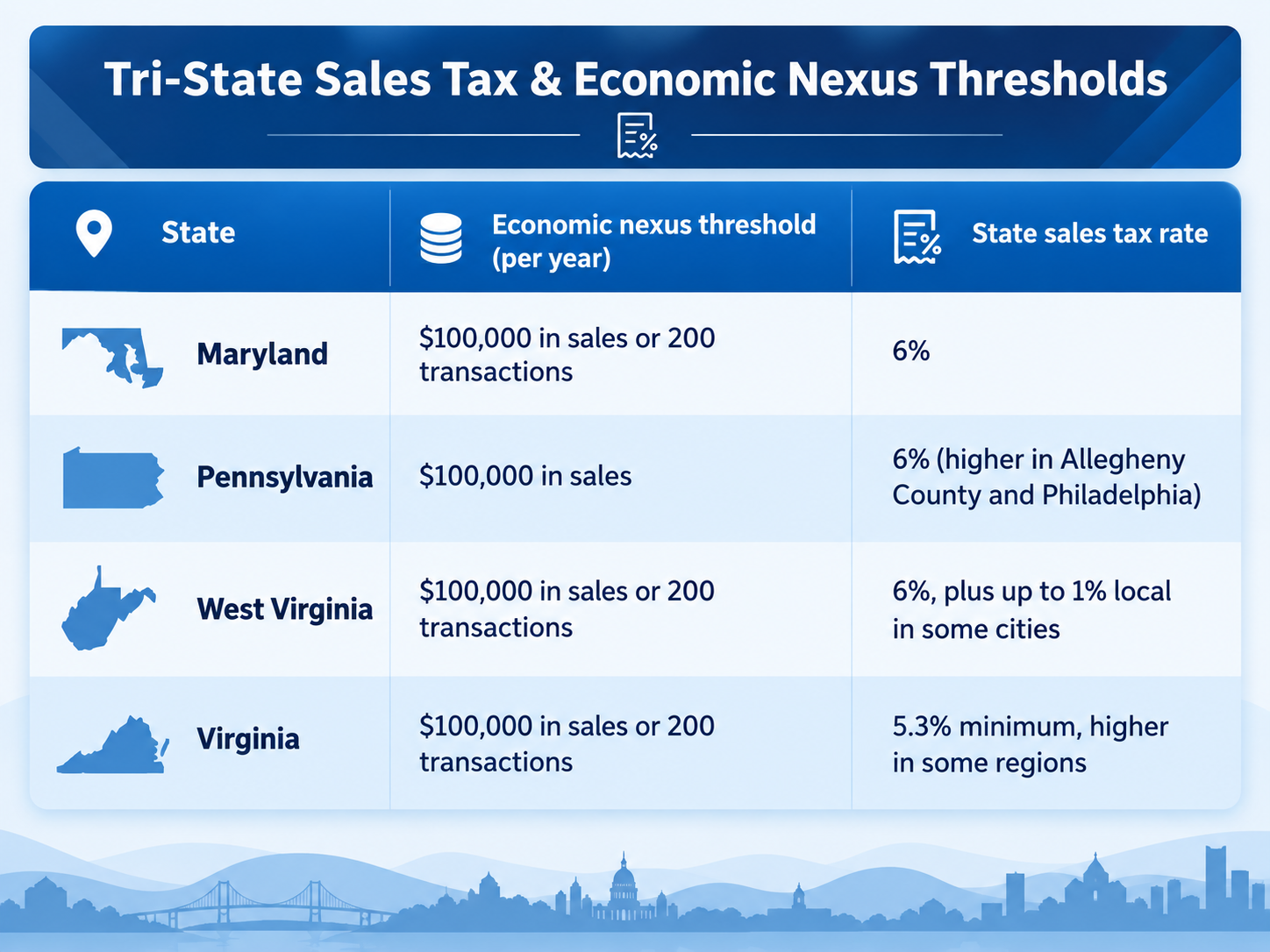
A few other things that trip people up:
- Each state taxes different things. A service that’s taxable in one state may be exempt next door. Don’t assume Maryland’s rules apply across the line.
- Where the sale lands matters. For shipped goods, the tax usually follows the delivery address, not your shop.
- Thresholds change. Check each state’s revenue department before relying on these numbers.
Doing business in another state
If you’re regularly working in another state, not just selling to customers there, you may need to register your business with that state. For an LLC or corporation, this is usually called registering as a “foreign” entity, and it comes with its own annual report and fees.
You may also owe a state income tax return where you earn revenue. Most states split your business income based on how much of your sales, payroll, or property is in each state. If you’re a sole proprietor or own an LLC or S corp, that can mean filing a nonresident personal return too.
What counts as “doing business” varies by state. A few jobs a year may not trigger it. A standing contract or a regular crew working across the line usually will.
Keeping your records clean across state lines
Multistate obligations are much easier to handle when your books are set up for them from the start. Here’s what we recommend:
- Track revenue by state. Use the location or class feature in QuickBooks (or your software’s equivalent) to tag every sale by the state it’s delivered to. This tells you when you’re getting close to a nexus threshold.
- Keep separate sales tax liability accounts. One account per state makes it easy to see what you owe where and reconcile each filing.
- Log where employees work. A simple record of job sites and dates backs up your payroll withholding and your income allocation if a state ever asks.
- Save exemption certificates. If a customer claims they’re tax-exempt or buying for resale, keep their certificate on file. Without it, you can be on the hook for the tax.
- Put every deadline on one calendar. Different states have different filing frequencies and due dates. One missed return can mean penalties and interest.
- Review it quarterly. Your business changes. A quick check each quarter catches new obligations before they turn into back taxes.
Let us handle the tri-state details
Working near three state lines is a real advantage for Hagerstown businesses. It just takes a little more care in the books. At Burke’s Bookkeeping, we help local owners set up payroll for out-of-state employees, track sales by state, and stay on top of filings in Maryland, Pennsylvania, West Virginia, and Virginia.
If you’re not sure whether you’ve picked up obligations in another state, reach out. We’ll review your setup and let you know where you stand.
This article is for general information and isn’t tax or legal advice. Rules change, so check with a professional about your specific situation.